You did it. You built a website. You optimized it. You started writing content. You’re checking all the boxes.
And now you’re thinking: “Finally. I can cross that off my list and get back to running my business.” Not so fast, websites are not ‘Set It and Forget It. That is a big mistake I see out there.
I get it. That feeling of relief is real. But here’s the hard truth: your website is not a “one and done” project.
Think of it like a garden. You don’t just plant the seeds, walk away, and expect fresh tomatoes six months later. You water it. You pull the weeds. You deal with the occasional pest. You show up, week after week, to keep it alive and growing.
Your website works the same way. If you treat it like a finished product, it will slowly—but surely—become a liability instead of an asset.
The Danger of the Digital Ghost Town
Let me paint you a picture.
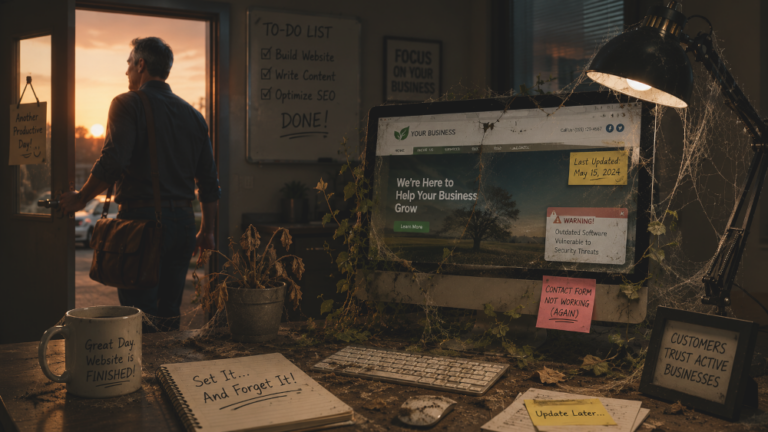
A potential customer finds your website. They’re interested. They click around. But the “About Us” page mentions a team member who left two years ago. The “Services” page lists prices that are no longer accurate. The last blog post is dated 2024.
What do they think?
“Are these people still in business?”
“Do they even care?”
“If they can’t keep their website updated, can I trust them with my project?”
That’s the cost of neglect. It’s not just a missed opportunity. It’s actively driving customers away. According to a 2024 study by the Pew Research Center, they found that nearly 40% of web pages that existed in 2013 were no longer accessible a decade later . That’s almost half of all digital content simply vanishing.
The Three Warning Signs Your Website Is Costing You
1. Broken Features
Forms that don’t submit. Buttons that go nowhere. Images that don’t load. Every broken feature is a customer who gave up and went to your competitor. And they won’t tell you about it—they’ll just leave.
2. Outdated Information
Pricing, hours, team bios, contact info—if any of this is wrong, you look sloppy at best and dishonest at worst. Customers don’t give you the benefit of the doubt. They assume you don’t care.
3. Stale Content
If your site hasn’t been updated in months (or years), it looks abandoned. Search engines notice too. Fresh content is one of the signals they use to determine if a site is still active and relevant. No updates = lower rankings.
What Happens When You Ignore Maintenance
Let me be blunt. I’ve seen it happen more times than I can count.
A business owner spends time and money building a great website. They’re thrilled with it. Then life gets busy, and the site starts collecting digital dust.
Six months later, a plugin update breaks the contact form. They don’t notice for weeks. Meanwhile, leads are filling it out—or trying to—and getting an error message. Those leads go to a competitor. The business owner wonders why sales are down.
A year later, the site gets hacked because they never applied security patches. Now they’re dealing with a blacklisted site, lost customer trust, and a hefty cleanup bill.
All of this was avoidable. It’s like not changing the oil in your car: you might save a few bucks today, but you’re looking at an engine rebuild tomorrow.
The Good News: It Doesn’t Have to Be Overwhelming
Here’s the thing—maintaining a website doesn’t have to be a full-time job. You just need a simple system.
Monthly Check-In (30 minutes)
- Update your plugins and software.
- Test your contact form.
- Review your analytics for any red flags.
- Check for broken links.
Quarterly Deep Clean (1-2 hours)
- Review all pages for outdated information.
- Add a new blog post or update an existing one.
- Check your Google Business Profile.
- Review your SEO performance.
Annual Audit (Half a day)
- Full backup of your site.
- Review design and functionality.
- Update your “About Us” and team pages.
- Plan your content for the coming year.
If you don’t have time for this—and many business owners honestly don’t—hire someone who does. I know, I know, that sounds self-serving. But look at it this way: a professional can handle all of this in a fraction of the time it would take you, and they’ll catch issues before they become problems.
The cost of maintenance is almost always less than the cost of a crisis.
This Isn’t Just About SEO
Yes, regular updates help with search rankings. Yes, fresh content keeps Google happy. But this is about something more important: your reputation.
Customers expect a professional, reliable online presence. When they see a website that’s clearly being maintained, it signals that you’re active, engaged, and trustworthy. When they see a site that’s been neglected, it signals the opposite.
You worked too hard to build your business to let a digital ghost town undermine all that hard work.
The Bottom Line
Your website is a living, breathing part of your business. It grows with you. It evolves with your customers. And it requires ongoing care and attention.
Don’t be the business owner who builds a great website and then lets it die on the vine. Stay engaged. Stay active. Stay relevant.
Because here’s the thing: you don’t have to be perfect. You just have to show up.
And showing up—regularly—is what separates the businesses that thrive online from the ones that fade away.
This post is part of our ongoing series on building a strong online presence. Be sure to check out the rest of the series: