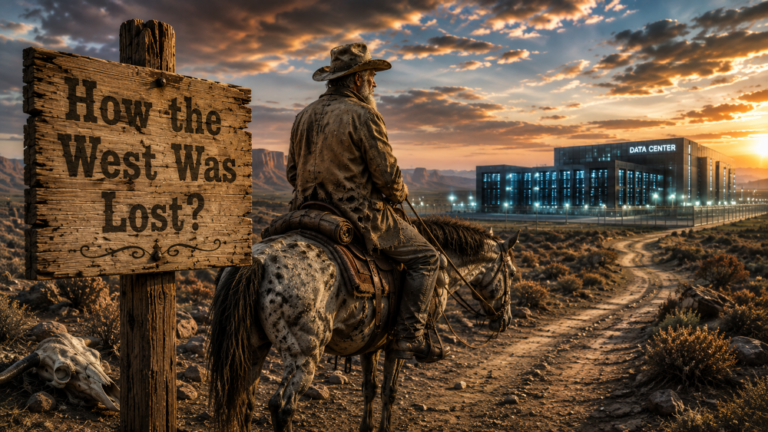
Spoiler alert: The Pony Express would have gone bankrupt.
Imagine waking up tomorrow and discovering that the internet had been invented in 1860.
There would be no smartphones, no laptops, and no Wi-Fi. You could check the news, send messages, buy things, and argue with complete strangers about politics—all before indoor plumbing became common and while most people still thought a “cloud” was something that rained on your crops. In other words, America would have invented Facebook before most households had a flush toilet. Modern marketing gurus love to claim that screen time changed who we are as human beings. But if we had Wi-Fi back when people were crossing the plains in covered wagons, it proves one simple truth: technology changes, but human nature remains the exact same brand of ridiculous. We’ve always been impatient, dramatic, easily distracted, and eager to argue.
The Rules of This Ridiculous Universe
Logins, Slow Connections, and Impatient Shopping
1. Your Internet Service Provider: The Pony Express Forget fiber. Your internet connection would arrive on horseback via Pony Express Internet & Telegraph Co. Their marketing slogan: “Because Waiting 10 Days Is Better Than Waiting 12.”
Your monthly plans:
- Basic: 5 messages per month
- Premium: 10 messages
- Business Pro: Unlimited messages* (*Subject to horse availability, weather, bandits, saddle sores, and whether the rider remembered where you live after the third whiskey stop.)
Customer service complaints would be legendary:
“My internet has been down for three days.” “What happened?”
“The horse got sick.”
“Can you escalate this?”
“Sir, the horse is currently in a veterinary quarantine tent outside Omaha. We’ll send a replacement as soon as we find one that doesn’t look at the saddle like it’s a personal insult.”
Outages would be announced with cheerful fatalism: “We’re experiencing higher than normal latency due to unexpected weather events and/or hostile Native American tribes and/or the rider falling off again.”
2. Amazon: The World’s Largest Mail-Order Catalog The Sears catalog would simply rebrand as Amazon and keep doing what it already did, only with more aggressive advertising.
You’d “order something online” by writing a carefully worded letter, mailing it to a wooden warehouse in the Midwest, having a clerk enter it into a leather-bound ledger, and waiting.
- Amazon Prime: Delivered in 2–3 Weeks. FREE SHIPPING! (Terms and conditions: Free shipping applies only if the package does not fall off the wagon, get eaten by wolves, or get redirected to the wrong state because the driver misread the address by lantern light.)
Modern Amazon customers who complain about two-day shipping would have been considered dangerously impatient and possibly un-American.
Social Media Drama & The In-Person Troll
3. Facebook: 1860 Edition Instead of uploading a photo from your phone, you’d hire a photographer. Your profile picture would take three hours because you had to sit perfectly still while the photographer exposed the plate. Any sudden movement and you’d end up looking like a blurry ghost with a mustache.
Status updates would be formal and slightly melancholy:
John Smith is feeling melancholy.
Replies (arriving 3 days later):
“Cheer up, John! The harvest looks promising this year.”
“Have you considered a tonic?”
“My cousin in Philadelphia recommends vigorous walking.”
By the time the replies arrived, John would either be over it or dead of consumption. Either way, engagement metrics were leisurely.
4. Twitter / X: Just Call It the Telegraph The character limit would be determined by how much you could afford to pay the operator. Every message ended with “STOP” so the clerk knew he could put the key down and stretch his fingers.
Imagine the political discourse:
ABRAHAM LINCOLN: WAR MAY BE COMING STOP
SOUTHERN STATES: DISAGREE STOP
SOME FELLOW IN OHIO: BOTH OF YOU ARE IDIOTS STOP The concept of “blocking” someone involved writing a strongly worded letter to the local telegraph office, hoping they remembered to stop delivering messages from that particular address.
5. The First Troll There would absolutely be trolls. They just wouldn’t be anonymous.
Their username would be something elegant like @CletusFromMissouri. Underneath every thoughtful post about crop rotation, you’d find: “YOUR OPINION IS STUPID.”
You’d ask the telegraph clerk for his profile details and discover:
- Cletus Johnson
- Location: 14 miles outside St. Louis
- Occupation: Professional Disagree-er and Occasional Farmer
The entire concept of an anonymous internet troll becomes considerably less attractive when the other guy can show up at your house on horseback, knock on your door, and continue the argument in person while your wife offers him coffee.
Marketing Scams, Cluttered Web Design, and Viral Chaos
6. Websites: A 37-Page Paper Pamphlet Imagine building a business website in 1860. No WordPress, no Elementor, no CSS, no JavaScript.
Your developer would hand you a stack of paper:
“Here’s your homepage.”
“It’s 37 pages.” “Why?”
“Your About section was unusually long. Also, we included three testimonials and a detailed map of how to find your store if the reader is coming from the east.” Your entire website was a printed booklet distributed by mail. Navigation instructions read: “Turn to page 14.” A 404 error was delivered with formal regret: “We regret to inform you that page 14 has been misplaced. Please accept our apologies and this complimentary leaflet about our spring fabric selection.”
7. SEO: Rankingsworth’s Patented Telegraph SEO Elixir Of course there would be SEO. Professor Rankingsworth would return, now selling Rankingsworth’s Patented Telegraph SEO Elixir—“The Miracle Cure for Low Rankings!”
He’d stand in the middle of the dusty street holding up a bottle, shouting: “Step right up, gentlemen! Buy now or regret it later!”
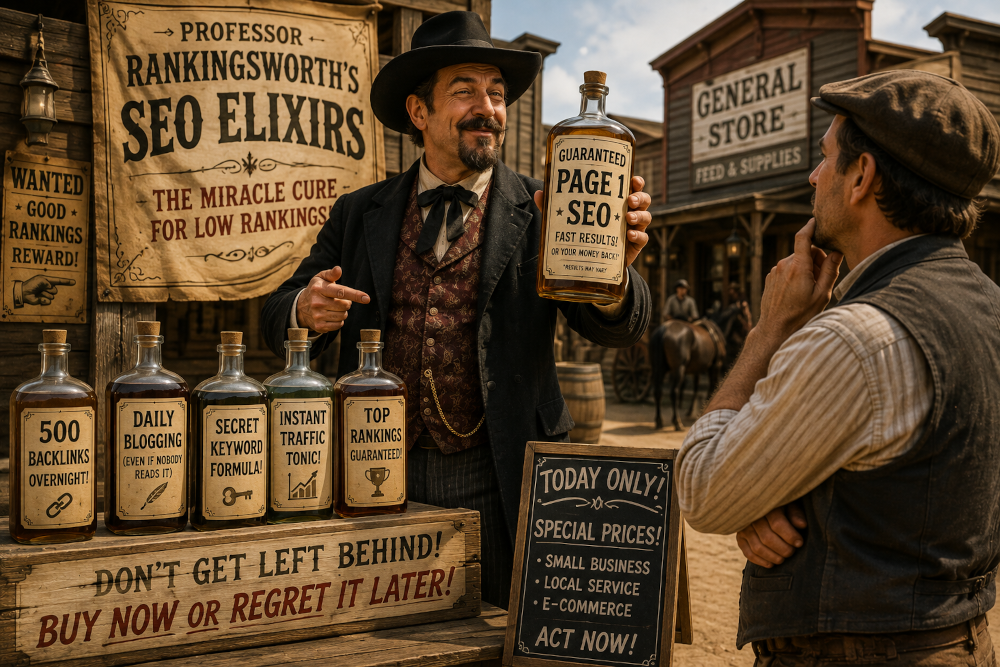
Professor Rankingsworth guarantees page-one rankings… results may vary.
His five secrets:
- Repeat your business name 400 times in every message.
- Get mentioned by important newspapers.
- Bribe the telegraph operator.
- Put your keyword in the headline.
- Never trust a man named Rankingsworth.
Someone would promise “GUARANTEED #1 POSITION IN GOOGLE,” and when informed Google doesn’t exist, pivot without missing a beat: “GUARANTEED #1 POSITION IN THE TELEGRAPH. Results may vary depending on operator sobriety.”
8. Electronic Mail (Email) Subject lines would already be a disaster: RE: RE: RE: RE: IMPORTANT BUSINESS MATTER.
Somebody would write: “Please remove me from your mailing list.”
The response, three days later: “Certainly. We will notify the telegraph operator. He has been informed. He may or may not remember.”
9. Going Viral Somebody in 1860 would invent the first viral video. It wouldn’t be a cat. It would be: “HORSE FALLS INTO BARREL — YOU WON’T BELIEVE WHAT HAPPENS NEXT!”
Twelve million people would hear about it via newspaper headlines. Someone would monetize it, someone else would steal it, someone would insist the horse was staged, and a local farmer would start a conspiracy theory that the government made the horse fall into the barrel as a distraction.
10. Digital Ghost Towns When an 1860 website failed, the owner would ride off, the last post would yellow in the sun, and the contact form would stop working. Years later, a traveler would ride through a digital ghost town: weathered signs promising services no one offers anymore, a “Last Updated” date that might as well be ancient history, a tumbleweed of broken links, and a lonely vulture perched on the About Us page.
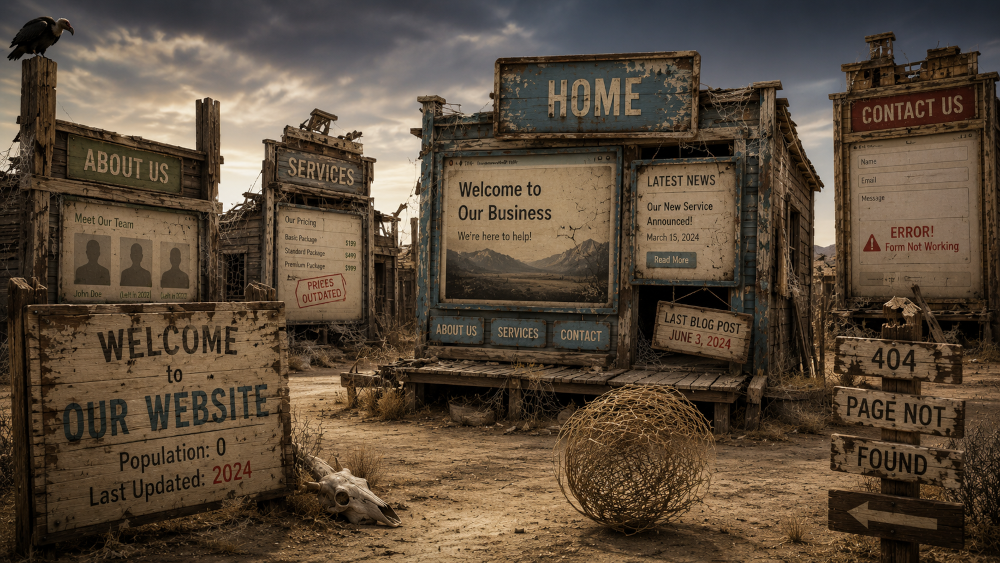
An abandoned website in 1860… or 2024. The technology is different. The emptiness is the same.
The Part That Hasn’t Changed
The technology may have changed, but the people haven’t.
We’d still argue, complain, fall for ridiculous advertising, try to sell each other junk, share daguerreotypes of animals doing stupid things, and spend far too much time “online”—even if online meant waiting for a horse.
The internet didn’t invent those behaviors. It just gave us faster ways to do them. Thankfully, we have Wi-Fi now, and the horses can finally enjoy the internet without having to deliver it.