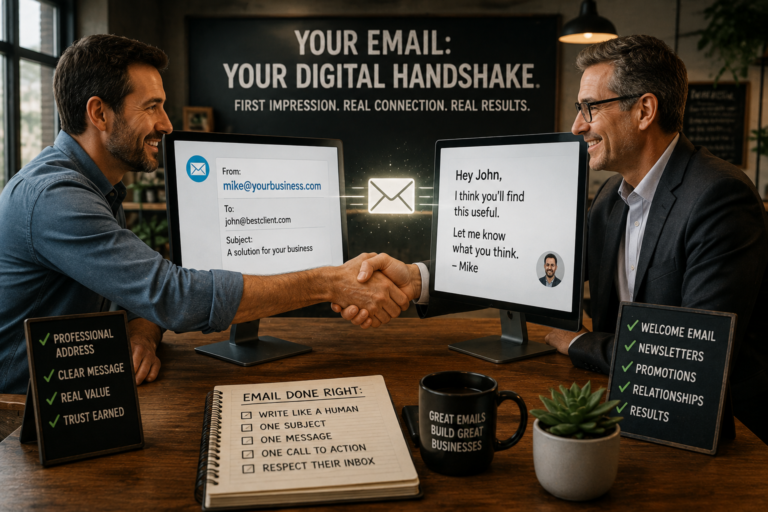
We’ve talked about why you need to ditch the @gmail.com address. It screams “side hustle” when you want to scream “legitimate business.” But getting a professional email is just the first step. It’s like buying a toolbox, now you actually have to use the tools.
Your email isn’t just a way to send messages. It’s your digital handshake, your storefront, and often your first impression. If you’re not using it strategically, you’re leaving customers, and money, on the table.
The Foundation: Why Professional Email Still Matters
I still see too many business owners using Gmail as their main business address. Here’s the thing: your email address is often the first thing a customer sees. If it’s name@yourbusiness.com, they instantly think: “This is a real company. I can trust them.”
If it’s business123@gmail.com? They think: “This is a side gig. Maybe I’ll keep looking.”
Set it up. If you have a domain, you can have email. It’s usually cheap or even free with your hosting. There’s no excuse.
How to Write Emails That Actually Get Opened
You’ve got the professional address. Now what? You still have to write something worth reading.
Write Like You Talk
If you wouldn’t say it out loud, don’t write it. Professional doesn’t mean robotic.
Instead of: “We are writing to inform you of our new service offerings that may be of interest to your organization.”
Try: “Hey [Name], we just launched something I think you’ll find useful.”
See the difference? One sounds like a form letter. The other sounds like a human being.
Read your email out loud before hitting send. If it sounds weird spoken, it’s going to read weird.
One Subject, One Message
Pick one thing. ONE. Your reader’s brain can only handle so much.
Strong subject line. Honest. Clear. Under 50 characters if possible. “Your free quote inside” beats “Here’s some information about our services.”
One clear call to action. What do you want them to do? Reply? Click a link? Call you? Tell them. Only once.
Mobile First
Over 60% of emails are opened on a phone. If your email doesn’t look good on a small screen, you’ve lost them.
Keep paragraphs short. Use bullet points. Make buttons big enough to tap with a thumb.
Building an Email List: The Right Way
Now let’s talk about collecting emails for promotions. This is where people get into trouble. They think the goal is to collect as many addresses as possible.
Wrong.
The goal is to collect consent from people who actually want to hear from you.
Get Permission. Real Permission.
This isn’t just good ethics—it’s the law. Under regulations like CAN-SPAM and GDPR, you can’t just add people because you found their email somewhere.
The rules are simple:
- Ask clearly. Use a checkbox that is NOT pre-ticked.
- Be honest about what they’re signing up for.
- Make unsubscribing easy. One-click unsubscribe. Every single time.
Offer Something Real in Exchange
Why would they give you their email? Because you gave them a reason.
This is called a lead magnet – something valuable in exchange for that address:
- A discount. 10% off their first service.
- A checklist. “5 Things to Check Before Hiring a Contractor.”
- A guide. “How to Prepare Your Home for a Deep Clean.”
- A free consultation.
It doesn’t have to be fancy. It just has to solve a problem for your customer.
Where to Collect Emails (Without Being Annoying)
- Your website. Add a signup form to your homepage and blog.
- Your physical location. A signup sheet at checkout.
- Social media. Share a link to your signup form.
- Events. Collect emails at trade shows or community events.
The Double Opt-In Question
Some platforms offer “double opt-in”, after someone signs up, they get a confirmation email they have to click.
This reduces your list size but dramatically improves quality. The people who confirm actually want to hear from you. Worth it.
What to Send: Four Emails Every Business Should Use
1. The Welcome Email
This is the most important email you’ll ever send. It has the highest open rate. Don’t waste it.
Include: Thank them, remind them what they signed up for, set expectations, offer something helpful.
2. The Regular Newsletter
Your consistent touchpoint, once a month or week.
Include: A useful tip, behind-the-scenes look, quick updates, one promotion (not more), clear call to action.
3. The Promotional Email
This is where you actually ask for the sale.
Rules: One clear offer, one clear call to action, create urgency (without being pushy), send to the right people.
4. The Re-Engagement Email
People go quiet. Before you remove them, send one last email.
Say: “We noticed you haven’t opened our emails. Do you still want to hear from us? If not, unsubscribe here (and we won’t be offended).”
A smaller, engaged list is worth far more than a huge list of people who ignore you.
The Bottom Line
Your email is more than a way to send messages. It’s a business tool. Use it that way.
Get a professional address. Write like you talk. Build your list the right way, with permission and value. Send emails people actually want to read.
Your customers are busy. Their inboxes are full. If you respect their time and give them something worthwhile, they’ll reward you with their attention.
And attention, in business, is worth everything.
Looking for more? Check out our post on Why Every Small Business Needs a Professional Email and our guide to writing content that actually connects.